On Erica Robyn Reads, Erica gives me a wonderful review! Check it out from the link to her website above. And the following sums up her thoughts:
My Final Thoughts on Dark Worlds We Wander –
Horror fans, you need this one immediately! The way that Kristin captured me at the start of each tale was incredible. I loved every single one of these stories!
No moral, no message, no prophetic tract, just a simple statement of fact: for civilization to survive, the human race has to remain civilized. -Rod Serling, The Twilight Zone, episode 68, “The Shelter”
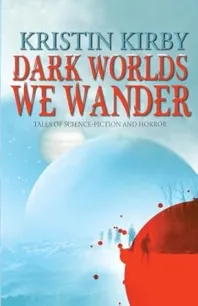
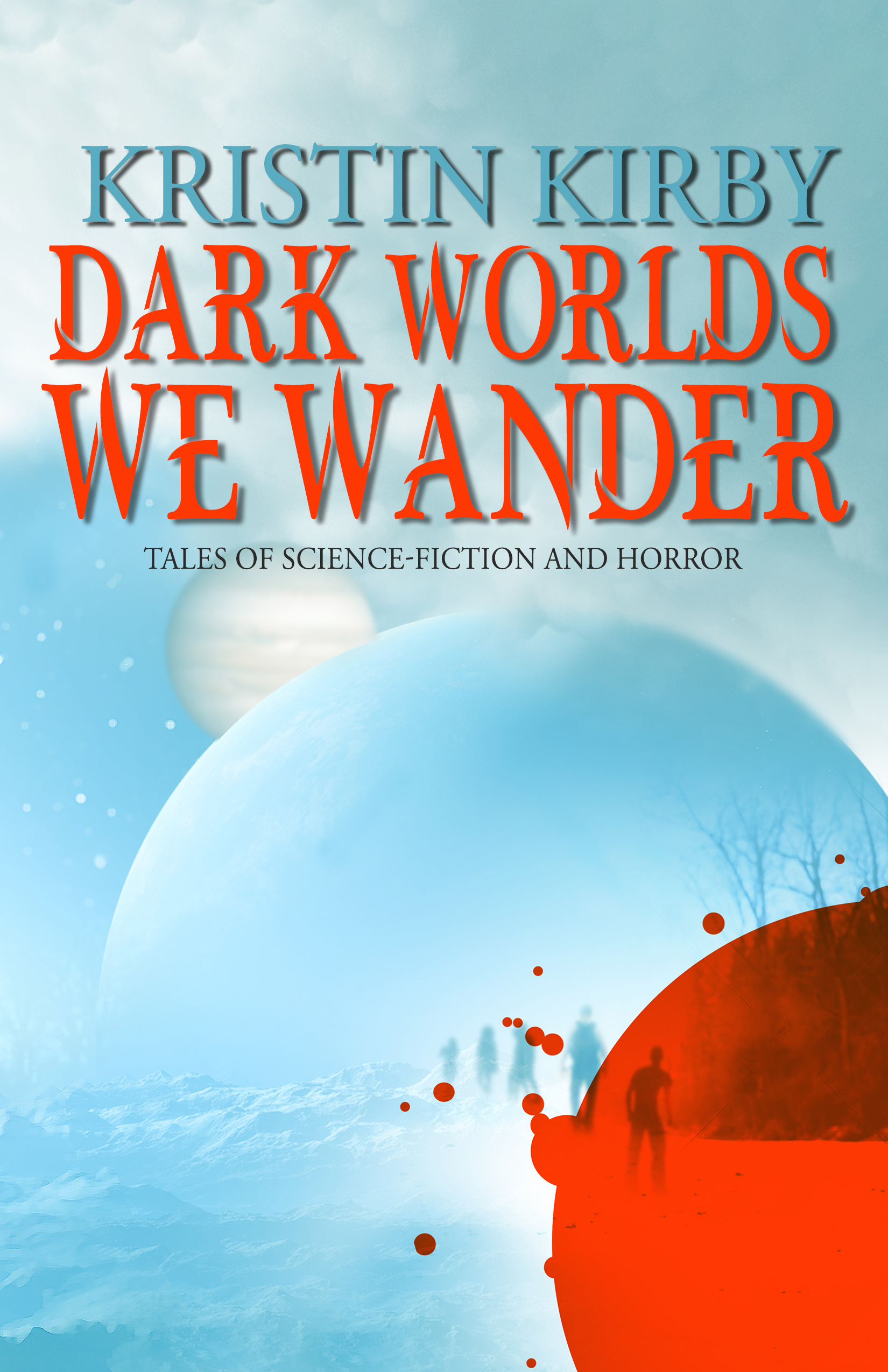
Dark Worlds We Wander cover
Kristin Kirby’s new collection, Dark Worlds We Wander, puts survival at the center of its narratives. In stories ranging from flash fiction to novellas, characters face hostile environments, post-apocalyptic societies, power-hungry despots, and humankind’s impulse to destroy. Yet all this violence highlights the importance of empathy in our relationships with the natural world and other living things. In the background of these dystopian horror and futuristic punk stories is an almost spiritual need to commune with nature: plant, animal, and—yes—extraterrestrial life.
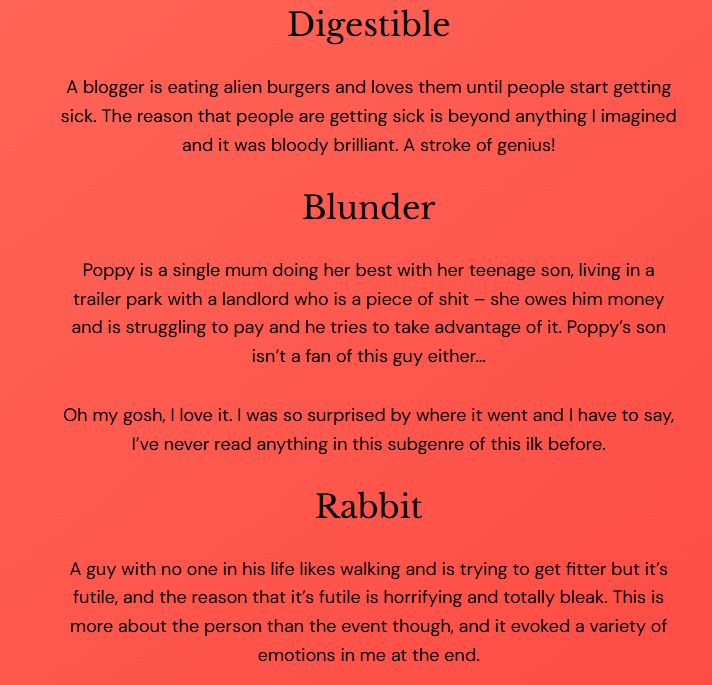
In the story “Rabbit,” three skyscraper-sized asteroids are hurtling toward Tanner’s part of Earth, but that won’t stop him from taking his doctor-prescribed daily walks to lower his blood pressure. Divorced and misanthropic, his exes left him because “he was distant. He wasn’t ‘there’” (p. 105). They weren’t wrong: In this moment of crisis he’s so detached that he’s incapable of acknowledging imminent danger. He ignores evacuation orders, deciding to wait until either the flow of migration settles down or the government comes up with a solution. As the town empties, it allows Tanner to retreat even more into a numb fatalism. Then on his walks he recognizes a rabbit that’s always at his resting spot. Eventually a familiarity develops between the two, awakening an animal compassion in Tanner at the thought of the rabbit suffering when the asteroids strike. Now, more than ever, Tanner is present. But what does it mean when the thought of a rabbit’s suffering means more than that of other humans? And how will it translate into action?
Some of Kirby’s stories explore fear and fascination with the weird and unknown. In “Imprints,” the protagonist gets a tattoo of her old pet mouse. But the tattoo begins multiplying on her skin, a new inked rodent appearing alongside the original. Is this her body reacting strangely? Is it a new form of life? What will happen if she lets it spread? How could she even stop it? The flash piece “Sojourn” explores a less complicated wonderment at the strange, only this time from the perspective of an extraterrestrial stranded on Earth. The alien’s sense of awe at the natural world and compassion for animal life generates some lovely observations on the beauty of nature; but the piece feels more like a scene than a story, a classic problem with flash fiction. The stranded visitor’s personal concerns, like the minor issue of her inability to return home unaided, certainly deserve more treatment. As is, the protagonist’s story is lost in her observation of a bird fighting off a rattlesnake.
In “Fly,” nature is an instrument of justice and a consoling friend. The protagonist, Luke, is about to serve a prison sentence on a dry, hostile planet. But first he must make a four-day walk to the prison from an undisclosed location with only a protective suit and six liters of water. Once he’s alone on his journey, he realizes that a fly has stowed away in his suit. As his trek progresses through this vast, inhospitable landscape, the relationship between Luke and the fly evolves, making for a surprisingly moving story.
Another example of the bleak and the beautiful is “Meat.” The story takes place in a barren, grey world, post-climate collapse. The unnamed protagonist is migrating aimlessly with a group of survivors until they stumble on a party that was slaughtered by marauders. There’s only one survivor: the Meat—a person the group keeps well-fed and healthy in order to cannibalize if they’re facing starvation. A clear literary descendant ofThe Road(2006), Kirby’s story of wandering cannibals is bleak but less so than McCarthy’s novel. This story is about the budding of a new society. These roaming bands of scavenger-cannibals are creating a culture, ceremonies, and rules to live by. When they include the Meat in their group, they perform a ritual that’s both meaningful and disturbing:
This is the fourth ceremony we’ve done; Brady started them as a way to make the Meats feel welcome and significant. We all give the new Meat something of ours—something precious. We eventually get it back anyway. I give him a silver belt buckle with a bucking bronco etched on it. I found it while scavenging. We ate the belt leather a while ago, but I kept the buckle. I like to trace the outline of the bucking horse with my fingers. It reminds me of the old days. (p. 22)
This rite sounds solemn and sinister, a sanctified fattening up and dressing of the Christmas turkey. But it’s a richly symbolic act. The belt buckle given by the narrator to the Meat is her connection to a happier past, the gift a kind of talisman that is more than just decorative. She’s giving up a pleasure that’s physical and emotional—touching the belt buckle, tracing the horse’s outline, soothes her with thoughts of a world that was comparatively without strife. This is the kind of ceremony religions can be built on. For the Meat’s life-sustaining body, they entrust him with a piece of themselves: their love, their faith, their soul. The Meat recognizes this on some level, as you can see in his response when, one day, the narrator asks why he looks so peaceful.
“I’m thinking of how lucky I am,” he says. He’s serious. “It’s sort of beautiful, don’t you think? The white frost on the ground, the bare, dark trees. I like how it’s so quiet. And the way our breath fogs up in the air. That means we’re breathing, right? That means we’re alive […] I was worthless before. I was a taker. But everything we do is important now. My life has meaning now. I’m important.” (p. 24)
Throughout all this, Kirby strikes the right balance between the profound and the practical, making the birth of this harsh new human culture feel not only natural but emotionally powerful. In these macabre ceremonies, those who sacrifice themselves teach others to see the beauty of their dark world. Nearness to death inspires more than fear. It transforms the Meats into philosophers, poets, or prophets. Society, culture, and religion give life meaning and can make even a dying Earth beautiful. Imagine that humans find a way to survive in this barren world. After a couple centuries of telling and retelling this exchange between the Meat and the narrator, you’d have the story of a new Jesus—only these followers cannibalize their savior literally, not symbolically with ceremonies of bread and wine.
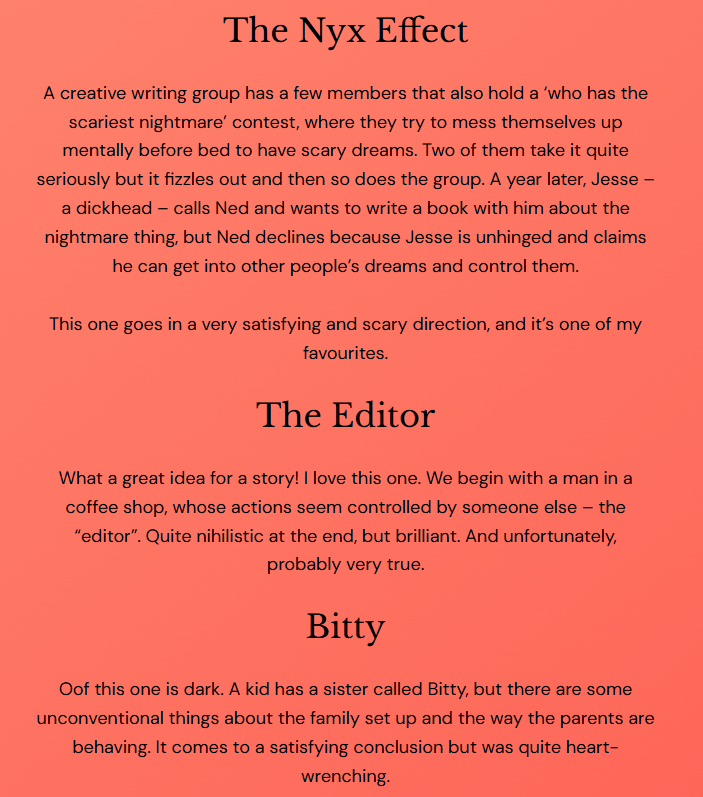
As palate cleansers, there are also some good, old-fashioned revenge stories with punishments for the present-day cruelties and egotism that could usher in the apocalypse. “Bitty” follows two sisters and their old-school patriarch of a father. One is an average girl and the other, Bitty, is a gentle-natured, multi-armed mutation with extraordinary strength that she can’t always control. Her father locks her in a cage and beats her whenever he lets her out, to the horror of her sister. But his abuse of Bitty only plays a minor role in their impetus for revenge. Likewise, the story “Blunder” follows a landlord who sexually assaults defenseless women tenants as payment for overdue rent. But he’s judged for another kind of violence—killing a spider, an act that almost all readers have committed without thinking. Justice in these stories is skewed and not always served out for the reasons we’d expect. But it doesn’t detract from the schadenfreude of seeing evil people suffer.
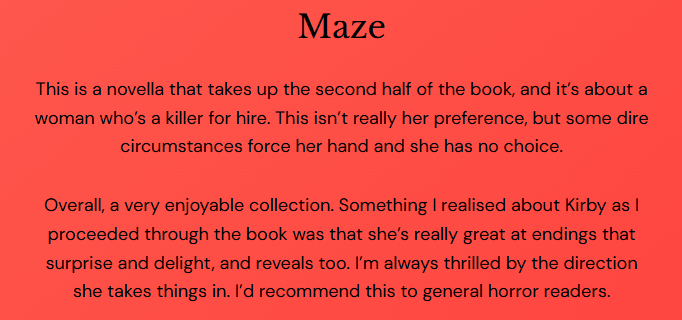
The final piece in the collection is an action novella, “Maze.” The titular character, Maze, is a former nurse turned hired assassin. On the cusp of a presidential election, she gets a call from her mysterious—but well-paying—employer, instructing her to assassinate three powerful men. If she fails, they’ll kidnap her two-year-old son. Naturally things don’t go according to plan and an action-packed chase ensues through dystopian cityscapes and desert wastelands. Maze pursues and is herself tracked in this high-stakes cat-and-mouse game by actual large mechanized police cats, a militarized police force, and giant man-eating lizards. What’s at stake? Only the fate of humanity. But Maze has to save her son first.
The novella marks a shift in style from the rest of the collection. After so many pieces in which an individual’s empathy and love (or lack thereof) play a central role in the narration, here readers have much less access to Maze’s emotional interior life. Take, for example, the moment she sees footage of her son being kidnapped.
On screen, two men with guns knock on Mrs. Brown’s door. A moment later the door opens. It’s over in seconds. One man shoots the old woman while the other goes into the apartment. He comes out holding Frankie by the waist. The little boy struggles. They disappear out of frame, leaving Mrs. Brown dying on the floor. Maze moans, stumbles away, and retches. She fights not to cry. (p. 137)
Maze isn’t emotionless, but the narration, in the removed third person, makes it more difficult to relate to her feelings. In close third person narration Kirby could have entered her thoughts and drawn from the memories and history that would make her reactions more personal. As the novella stands, what we read is primarily physical description, the kind of thing you’d see on a surveillance camera. With the removed third person, we don’t have direct access to the unique nature of Maze’s despair. Unlike with the characters in the collection’s other stories, we don’t see how her internal life supports or contrasts her external actions.
So why didn’t Kirby write this novella in close third person? Possibly because this removed third person point of view gives the writer more agility with action scenes and Kirby exploits its potential well. Take this scene where Maze is being chased by a “Cop Copter”:
Maze races out the park gates, the Copter almost on top of her— She reaches into her boot, feeling around— Pulls out a thumb-sized electronic device— Attaches it to her gun— And flings the gun up at the Copter— Where it lodges in the landing gear. Maze heads at a staggering run the other way— As the landing gear explodes. The Copter, in flames, careens slantways, engine shrieking— And crashes in a heap in the trees. Maze keeps running. (pp. 125-6)
Is this poetry? Not really. But as Maze dives for cover, shoots down countless enemies, and lobs thumb-sized grenades at military helicopters, the speed and animation of the prose gives you an exciting sense of agency in the story. The feeling of involvement is similar to that of a video game. As if you had a phantom console controller in your hands, you have the impression of directing Maze into the park, hitting B, A, left, right, and C, dodging, diving, taking the explosive out of storage, and taking down the Copter yourself. No, there aren’t lyrical acrobatics in this story, but there are certainly some narrative-psychological ones that Kirby has used to great effect.
Indeed, Kirby’s diversity of styles and characters give this book the feel of a 1950s speculative radio series. That was a bleak time characterized by Second Red Scare McCarthyite censorship and oppression, but it was also one of brilliantly entertaining speculative storytelling. Like those classic SFF narratives, some stories here are more successful than others; but Dark Worlds We Wander will get you tying literary and political pasts, presents and futures together. You can’t read this collection without thinking of our current, insufficient, reactions to climate change and the ever-worsening presence of cruelty and cynicism in politics. These unspoken, yet evident, resonances tie many of these stories together and place the book in SFF’s long tradition of social critiques hiding in plain sight. You’ll find reasons for terror and comfort sitting side by side throughout Dark Worlds We Wander. It offers fun reading as you retire to a quiet spot in the bunker and await the end of modern civilization.
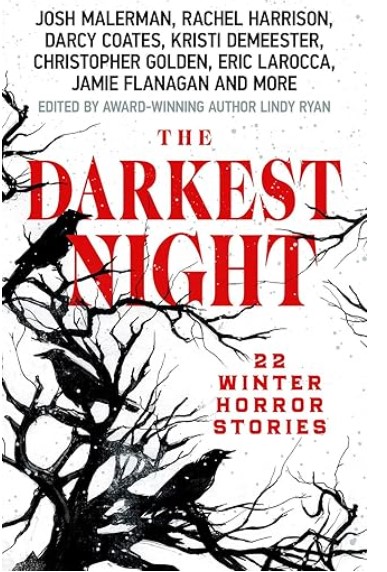
It’s that time of year—when weeks and weeks of so much cuteness and cheer make you really want to read some good horror stories. Thankfully, editor Lindy Ryan and publisher Crooked Lane Books present us with The Darkest Night, an anthology of “chilling stories” about the holidays from some of the best writers of horror and speculative fiction working today.
There are lots of great stories in this highly recommended anthology, but a few stood out for me.
In Gwendolyn Kiste’s “The Mouthless Body in the Lake,” we empathize with the narrator’s forlorn existence, the icy chill of her world and, finally, hope as she confronts what’s keeping a deep part of her prisoner for so long.
I experienced a real growing dread as I turned the pages of “Children Aren’t the Only Ones Who Know Where the Presents Are Hidden” by Josh Malerman. Josh mines the terror of confused childhood Christmas memories and creates new alloys of fear and redemption.
In “The Vermin Moon,” Hailey Piper takes a mother’s grief and twists it until we feel it in our own hearts. I wanted a different ending for her protagonist Melanie, but sometimes even Christmas wishes don’t come true.
“I Hope This Finds You Well” by Eric LaRocca feels like a wonderful homage to refined horror tales of the 19th century, but then the horror keeps intensifying, and there’s that punch ending. Love this story.
M. Rickert’s “The Buried Child” carries you along like a fairy tale or a river, all mysterious depths and turns and revelations. Poor Marlene’s suffering is couched in Mary’s dreamlike writing, but we still feel the terrible poignancy of her dilemma.
Sometimes a good thing turns out to be bad, and vice versa. Rachel Harrison in her story “Thaw” giddily dances that fine line, as we realize with rising horror things aren’t going to end well for one of the characters. But sometimes that’s a good thing.
If you love hard-hitting podcasts, you should check out Parcast network. Parcast does scripted podcasts on a variety of intense subjects like Haunted Places, Unexplained Mysteries, Unsolved Murders, Historical Figures, Assassinations, Kingpins, and more.
The first episode of the first podcast I wrote for Parcast premiered today. I’m so excited! It’s for their show Conspiracy Theories, and it’s about “FEMA Death Camps.” Part two will air next week.
Consummate actors Molly Brandenburg and Carter Roy narrate, and they are awesome. Here’s the link to Conspiracy Theories: https://www.parcast.com/conspiracy.
In 2001, I fulfilled a dream and traveled to Africa. Our small group toured Namibia by Land Rover, visiting wildlife reserves, massive orange dunes, arid diamond fields, and quaint coastal towns. Later we would stay at a camp in Zimbabwe and ride elephants and stand in the spray of Victoria Falls, but those first hypnotic days on the open road gazing at the Namibian landscape, with giraffes clubbing among the camelthorns or pale chanting goshawks soaring like ghosts above the savanna or a lone hyena step-and-hitching parallel to our truck for miles, remain with me even now.
I got to take the controls of a Cessna on that trip. We went for a twilight boat ride down the Zambezi among a herd of hippos. One day we saw flamingoes in the morning and penguins in the afternoon. But my favorite memory of Africa was the evening spent at a ghost town out in the Namib Desert called Kolmanskop.
The little German village, built in 1908 for diamond miners and their families, was abandoned in 1954. In the years since, the desert has been slowly reclaiming its own, swallowing homes, the hospital, school, ballroom, and other buildings. The glass in most windows is gone, doorways are filled almost completely with sand, wood floors are rotting, and plaster is cracking and turning to powder in the relentless heat and wind.
Our group was allowed free run of the place, our guides promising to pick us up after a few hours. We explored the dusty grounds and crumbling buildings, taking photos and marveling at how grand the town must have been in its heyday, yet how remote. I was fascinated with the rooms filled so high with sand, nervous as I crawled through a cramped doorway, thinking about cave-ins.
As dusk fell, my friends headed outside to wait for our guides. I wanted to stay longer, absorb more of the atmosphere. In the mayor’s house, I carefully made my way up creaky stairs to the second floor. The floorboards were broken through in many places; in the dimming light, I could see the first floor below. At a window, I waved to the others outside.
The sudden surge of loneliness, foreboding, and menace hit me like a hard wind. My skin prickled. I was aware of a presence on that second floor. Whoever—whatever—still lived in the shifting sands and empty rooms of Kolmanskop was fine with visitors during the day. But when night came, this place belonged to them, and they didn’t want me there.
I was afraid to turn from the window, to see who was sending me such hateful feelings. But it was getting darker by the minute. I said it out loud, emphatic: “I’m leaving. Thank you. Be well. I wish you well.” My eyes wide in the dark, I shuffled past the gaps in the floor and stepped cautiously down the stairs and out to the yard. And took a shaky breath before joining the group.
I wanted to share clips of my friend Terese’s work. She’s making a stop-motion movie of one of my short screenplays. Here are a couple of “screen tests” of the main characters.
Jeff came in from his studio last night carrying an old doll’s head and a rusty piece of iron welded to four wooden casters and declared, “I’m running out of junk. I need to get more.” The lighting piece in this photo is made from junk, er, found objects, including part of a vintage boat motor Jeff found in the park where we run. One person’s trash is another person’s treasure, and all that. It’s all about perspective.
I’m big on perspective. Everything is perspective. Its archaic definition is “an optical glass, a telescope.” That’s definitely different from the naked, unadulterated eye. Even nowadays it can mean both an actual, physical view or a mental one, outside or in. Then there’s the visual artist’s definition as it relates to giving the illusion of depth and distance.
A hundred people can look at the Mona Lisa and each have a different opinion. What’s that fable about the six blind people describing the elephant? The one touching the trunk says an elephant is like a rope. The one touching the belly says it’s like a wall. The one touching the tusk says it’s like a pipe. And so on. Some people think THE BABADOOK was great; I think it needed 10 more minutes of scary to make it ascend into awesomeness. As a writer, I can look at what I’ve put on the computer screen and see it differently than what’s on the page out of the printer.
I can look out at the rain and be glad it’s watering my flowers. An hour later I can be frustrated because I want to get out and weed said flowers and not get wet. Perspective.
Age changes perspective. So does time. Space. Information. Education. Wealth or poverty. It’s relative, right? I’m reading Slaughterhouse Five again. Haven’t read it since I was in my 20s. I know my perspective is going to be different now.
I love that. It makes life so interesting. Everything is perspective.



 Kristin Kirby